Sunday, February 2, 2025

Thursday, September 22, 2016
Happiness in Life
Leo Rosten, writer, scientist, professor, has made a statement that gives us purposes to ponder:
“Where was it ever promised us that life on this earth can ever be easy, free from conflict and uncertainty, devoid of anguish and wonder and pain? …
“The purpose of life is to matter, to be productive, to have it make some difference that you lived at all. Happiness, in the ancient, noble sense, means self-fulfillment—and is given to those who use to the fullest whatever talents God … bestowed upon them.”
He continues: “Happiness, to me, lies in stretching, to the farthest boundaries of which we are capable, the resources of the mind and heart.” (This Week Magazine, 20 Jan. 1963, p. 2.)
Monday, September 19, 2016
Power of the Word
President Benson counseled: “Immerse yourselves in [the scriptures] daily so you will have the power of the Spirit.” (Ensign, May 1986, p. 82.)
President Kimball said, “I find that when I get casual in my relationships with divinity and when it seems that no divine ear is listening and no divine voice is speaking, that I am far, far away. If I immerse myself in the scriptures the distance narrows and the spirituality returns.” (The Teachings of Spencer W. Kimball, ed. Edward L. Kimball, Salt Lake City: Bookcraft, 1982, p. 135.)
Thursday, July 9, 2015
The Same is Forgiven
Friday, May 15, 2015
Christ Can Help Us
Sunday, April 5, 2015
He Is Risen
Given the reality of the Resurrection of Christ, doubts about the omnipotence, omniscience, and benevolence of God the Father—who gave His Only Begotten Son for the redemption of the world—are groundless. Doubts about the meaning and purpose of life are unfounded. Jesus Christ is in fact the only name or way by which salvation can come to mankind. The grace of Christ is real, affording both forgiveness and cleansing to the repentant sinner. Faith truly is more than imagination or psychological invention. There is ultimate and universal truth, and there are objective and unchanging moral standards, as taught by Him.Given the reality of the Resurrection of Christ, repentance of any violation of His law and commandments is both possible and urgent. The Savior’s miracles were real, as is His promise to His disciples that they might do the same and even greater works. His priesthood is necessarily a real power that “administereth the gospel and holdeth the key of the mysteries of the kingdom, even the key of the knowledge of God. Therefore, in the ordinances thereof, the power of godliness is manifest.” Given the reality of the Resurrection of Christ, death is not our end, and though “skin worms destroy [our bodies], yet in [our] flesh shall [we] see God.” (The Resurrection of Jesus Christ, General Conference, April 2014.)
Saturday, March 28, 2015
He Took My Licken' For Me
I have a simple story I would like to recount. It is something of a parable. I do not have the name of the author. Perhaps it will have special interest for our children. I hope it will be a reminder for all.
“Years ago there was a little one-room schoolhouse in the mountains of Virginia where the boys were so rough that no teacher had been able to handle them.
“A young, inexperienced teacher applied, and the old director scanned him and asked: ‘Young fellow, do you know that you are asking for an awful beating? Every teacher that we have had here for years has had to take one.’
“‘I will risk it,’ he replied.
“The first day of school came, and the teacher appeared for duty. One big fellow named Tom whispered: ‘I won’t need any help with this one. I can lick him myself.’
“The teacher said, ‘Good morning, boys, we have come to conduct school.’ They yelled and made fun at the top of their voices. ‘Now, I want a good school, but I confess that I do not know how unless you help me. Suppose we have a few rules. You tell me, and I will write them on the blackboard.’
“One fellow yelled, ‘No stealing!’ Another yelled, ‘On time.’ Finally, ten rules appeared on the blackboard.
“‘Now,’ said the teacher, ‘a law is not good unless there is a penalty attached. What shall we do with one who breaks the rules?’
“‘Beat him across the back ten times without his coat on,’ came the response from the class.
“‘That is pretty severe, boys. Are you sure that you are ready to stand by it?’ Another yelled, ‘I second the motion,’ and the teacher said, ‘All right, we will live by them! Class, come to order!’
“In a day or so, ‘Big Tom’ found that his lunch had been stolen. The thief was located—a little hungry fellow, about ten years old. ‘We have found the thief and he must be punished according to your rule—ten stripes across the back. Jim, come up here!’ the teacher said.
“The little fellow, trembling, came up slowly with a big coat fastened up to his neck and pleaded, ‘Teacher, you can lick me as hard as you like, but please, don’t take my coat off!’
“‘Take your coat off,’ the teacher said. ‘You helped make the rules!’
“‘Oh, teacher, don’t make me!’ He began to unbutton, and what did the teacher see? The boy had no shirt on, and revealed a bony little crippled body.
“‘How can I whip this child?’ he thought. ‘But I must, I must do something if I am to keep this school.’ Everything was quiet as death.
“‘How come you aren’t wearing a shirt, Jim?’
“He replied, ‘My father died and my mother is very poor. I have only one shirt and she is washing it today, and I wore my brother’s big coat to keep me warm.’
“The teacher, with rod in hand, hesitated. Just then ‘Big Tom’ jumped to his feet and said, ‘Teacher, if you don’t object, I will take Jim’s licking for him.’
“‘Very well, there is a certain law that one can become a substitute for another. Are you all agreed?’
“Off came Tom’s coat, and after five strokes the rod broke! The teacher bowed his head in his hands and thought, ‘How can I finish this awful task?’ Then he heard the class sobbing, and what did he see? Little Jim had reached up and caught Tom with both arms around his neck. ‘Tom, I’m sorry that I stole your lunch, but I was awful hungry. Tom, I will love you till I die for taking my licking for me! Yes, I will love you forever!’”
To lift a phrase from this simple story, Jesus, my Redeemer, has taken “my licking for me” and yours for you.
Declared the prophet Isaiah:
“Surely he hath borne our griefs, and carried our sorrows: …
“… He was wounded for our transgressions, he was bruised for our iniquities: the chastisement of our peace was upon him; and with his stripes we are healed” (Isa. 53:4–5).
This is the wondrous and true story of Christmas. The birth of Jesus in Bethlehem of Judea is preface. The three-year ministry of the Master is prologue. The magnificent substance of the story is His sacrifice, the totally selfless act of dying in pain on the cross of Calvary to atone for the sins of all of us.
Saturday, February 28, 2015
Come Unto Christ
"So how does one “come unto Christ” in response to this constant invitation? The scriptures give scores of examples and avenues. You are well acquainted with the most basic ones. The easiest and the earliest comes simply with the desire of our heart, the most basic form of faith that we know. “If ye can no more than desire to believe,” Alma says, exercising just “a particle of faith,” giving even a small place for the promises of God to find a home—that is enough to begin."
Thursday, February 12, 2015
We Look to Christ
Monday, February 2, 2015
Come Unto Me

Among the most moving lamentations of the Lord was to those who did hear his teachings and yet would not believe.
"O Jerusalem, Jerusalem, thou that killest the prophets, and stonest them which are sent unto thee, how often would I have gathered thy children together, even as a hen gathereth her chickens under her wings, and ye would not!" Matthew 23:37On another occasion, the Savior expressed gratitude for the humble people who did hear his teachings and did believe. With reassurance to these new believers and concern for those not choosing to follow him, Christ issued a profound invitation in what Elder James E. Talmage has appropriately called “one of the grandest outpourings of spiritual emotion known to man.” (Jesus the Christ, 3d ed., Salt Lake City: The Church of Jesus Christ of Latter-day Saints, 1916, p. 258.) These are the words of the Master used in making this appeal:
“Come unto me, all ye that labour and are heavy laden, and I will give you rest.
“Take my yoke upon you, and learn of me; for I am meek and lowly in heart: and ye shall find rest unto your souls.
“For my yoke is easy, and my burden is light." Matthew 11:23-24
Of this invitation, Howard W. Hunter, a former president of the Church of Jesus Christ of Latter- day Saints shared this insight,
"This invitation and promise is one of the most oft-quoted of all scripture and has been of untold comfort and reassurance to millions. Yet there were those among his hearers that day whose vision was so limited that they could see only a carpenter’s son speaking of a wooden yoke. A yoke which, from time to time, he had undoubtedly hewn and shaped from heavy wooden timbers for the oxen of these same men who were listening.
"Elder Talmage added: “He invited them from drudgery to pleasant service; from the well-nigh unbearable burdens of ecclesiastical exactions and traditional formalism, to the liberty of truly spiritual worship; from slavery to freedom; but they would not.” (Jesus the Christ, p. 259.)
"Here was a prophetic appeal and magnificent promise to a troubled people facing great peril, but they could not understand it. He knew what lay ahead for them even if they did not, and he was inviting them to come unto him to find rest and safety for their troubled souls. Had he not already shown them that he could give rest to those who labored with profound illness and disease? Had he not already relieved the burden of those who were heavily laden with sin and the cares of the world? Had he not already raised one from the dead, proving that he possessed the divine power to relieve even that greatest of all universal burdens? And yet most would still not “come unto [him].”
"Unfortunately, a refusal to accept his miracles and his glorious invitation is still seen today. This marvelous offer of assistance extended by the Son of God himself was not restricted to the Galileans of his day. This call to shoulder his easy yoke and accept his light burden is not limited to bygone generations. It was and is a universal appeal to all people, to all cities and nations, to every man, woman, and child everywhere.
"In our own great times of need we must not leave unrecognized this unfailing answer to the cares and worries of our world. Here is the promise of personal peace and protection. Here is the power to remit sin in all periods of time. We, too, must believe that Jesus Christ possesses the power to ease our burdens and lighten our loads. We, too, must come unto him and there receive rest from our labors.
"Of course, obligations go with such promises. 'Take my yoke upon you' he pleads. In biblical times the yoke was a device of great assistance to those who tilled the field. It allowed the strength of a second animal to be linked and coupled with the effort of a single animal, sharing and reducing the heavy labor of the plow or wagon. A burden that was overwhelming or perhaps impossible for one to bear could be equitably and comfortably borne by two bound together with a common yoke. His yoke requires a great and earnest effort, but for those who truly are converted, the yoke is easy and the burden becomes light.
"Why face life’s burdens alone, Christ asks, or why face them with temporal support that will quickly falter? To the heavy laden it is Christ’s yoke, it is the power and peace of standing side by side with a God that will provide the support, balance, and the strength to meet our challenges and endure our tasks here in the hardpan field of mortality.
"Obviously, the personal burdens of life vary from person to person, but every one of us has them. Furthermore, each trial in life is tailored to the individual’s capacities and needs as known by a loving Father in Heaven. Of course, some sorrows are brought on by the sins of a world not following the counsel of that Father in Heaven. Whatever the reason, none of us seems to be completely free from life’s challenges. To one and all, Christ said, in effect: As long as we all must bear some burden and shoulder some yoke, why not let it be mine? My promise to you is that my yoke is easy, and my burden is light."
Friday, January 2, 2015
Peace Through Prayer
Elder Richard L. Evans said,
There is terrible suffering in our world today. Tragic things happen to good people. God does not cause them, nor does He always prevent them. He does, however, strengthen us and bless us with His peace, through earnest prayer.
“It is not the usual purpose of prayer to serve us like Aladdin’s lamp, to bring us ease without effort,” Elder Richard L. Evans wrote. “Prayer is not a matter of asking only. It should not be always as the beggar’s upturned hand. Often the purpose of prayer is to give us strength to do what needs to be done, wisdom to see the way to solve our own problems, and ability to do our best in our tasks.
“We need to pray … for strength to endure, for faith and fortitude to face what sometimes must be faced.” (The Man and the Message, Salt Lake City: Bookcraft, 1973, p. 289.)
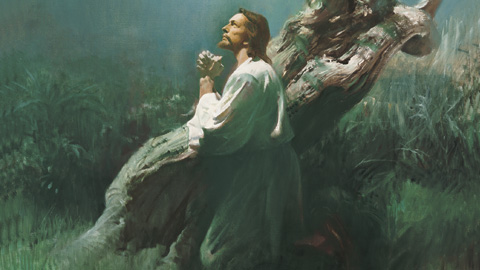
It was the Lord himself who taught us by His own example how to find peace when the answers we receive are not what we asked for. On the eve of His crucifixion, with “soul … exceeding sorrowful, even unto death,” Jesus knelt in the Garden of Gethsemane and prayed to the Father, saying, “O my Father, if it be possible [and he acknowledged ‘all things are possible unto thee’], let this cup pass from me: nevertheless not as I will, but as thou wilt.”
If we, like the Savior, have the faith to put our trust in our Father in Heaven, to submit to His will, the true spirit of peace will come as a witness and strength that He has heard and answered our prayers.
Sunday, December 7, 2014
His Arms of Mercy and Love are Outstretched Still
The Savior’s perfect and infinite arms of love give us the strength to endure heartache and hardship, the power to resist temptation, and the courage to keep the commandments even as we are being mocked and scorned by those in the “great and spacious building” (1 Nephi 11:36). From his own personal experiences, Paul clearly understood the strengthening power of the Lord’s arms of love. He testified:
“Who shall separate us from the love of Christ? shall tribulation, or distress, or persecution, or famine, or nakedness, or peril, or sword? …Each of us is mortal. We are all, as King Benjamin described us, “natural,” fallen men and women, “enem[ies] to God” (Mosiah 3:19). No matter how strong we believe we may be, or how diligent, or how productive we think we are— these, alone, can never save us in the celestial kingdom of God. It is only through the Atonement of Christ that we can be saved. He not only can save us but also can strengthen us. That is what we call grace.
“For I am persuaded, that neither death, nor life, nor angels, nor principalities, nor powers, nor things present, nor things to come,
“Nor height, nor depth, nor any other creature, shall be able to separate us from the love of God, which is in Christ Jesus our Lord” (Romans 8:35, 38–39).
Grace is an enabling power. Elder David A. Bednar of the Quorum of the Twelve Apostles has taught,
“The enabling power of the Atonement of Christ strengthens us to do things we could never do on our own.”

Consider this important principle is found in Matthew chapter 14. As the disciples watched the Savior walk on the Sea of Galilee toward their boat, they thought they were seeing a ghost. Jesus assured them that it was He and that they need not be afraid. Peter declared, “Lord, if it be thou, bid me come unto thee on the water” (verse 28). Jesus said, “Come.” Matthew then records, “And when Peter was come down out of the ship, he walked on the water, to go to Jesus” (see Matthew 14:24–29).
What followed is significant. I can’t relate to walking on water, but I can relate to what Peter experienced next:
“But when he saw the wind boisterous, he was afraid; and beginning to sink, he cried, saying, Lord, save me.All of us have had, are having, or will yet have a Peter-like “sinking” experience in some way and will at some time (probably many times) cry out, “Lord, save me.” Peter could not save himself. He needed the rescuing arms of Christ, and so do we. Can you imagine Peter—choking, flailing his arms while struggling to keep his head above water—saying as the Savior extends His arms: “You're very kind [gasp] but no, thank you. I'll just swim to shore. I sank myself [gasp], so I must save myself. Oh, which way to shore?”? Of course not. Sounds ridiculous doesn't it. The truth is we sometimes do just that.
“And immediately Jesus stretched forth his hand, and caught him, and said unto him, O thou of little faith, wherefore didst thou doubt?
“And when they were come into the ship, the wind ceased.
“Then they that were in the ship came and worshipped him, saying, Of a truth thou art the Son of God” (Matthew 14:30–33.)
We may recognize in our heads that we are deficient—in fact, utterly incapable of rescuing or redeeming ourselves—but we sometimes resist, even recoil from, the outstretched arms of the Savior's love. Sometimes we spiritually drown ourselves because we won’t reach up and take his hand. Elder Jeffrey R. Holland of the Quorum of the Twelve eloquently stated:
“May I be bold enough to suggest that it is impossible for anyone who really knows God to doubt his willingness to receive us with open arms in a divine embrace if we will but ‘come unto Him.’ …President George Q. Cannon (1827–1901) declared:
“I am convinced that none of us can appreciate how deeply it wounds the loving heart of the Savior of the world when he finds that his people do not feel confident in his care or secure in his hands.”
“No matter how serious the trial, how deep the distress, how great the affliction, He will never desert us. He never has, and He never will. He cannot do it. It is not His character [to do so]. He is an unchangeable being; the same yesterday, the same today, and He will be the same throughout the eternal ages to come. We have found that God. We have made Him our friend, by obeying His Gospel; and He will stand by us. We may pass through the fiery furnace; we may pass through deep waters; but we shall not be consumed nor overwhelmed. We shall emerge from all these trials and difficulties the better and purer for them, if we only trust in our God and keep His commandments.” (George Q. Cannon, in Collected Discourses Delivered by President Wilford Woodruff, His Two Counselors, the Twelve Apostles, and Others (1988), 2:185.)I am grateful for the Lord’s arms of love and mercy. I am grateful that He has rescued me, not only from physical death and sin but also from myself—my fears, my discouragement, my doubts, and my feelings of inadequacy. Reach up in faith to him. His arms of mercy and love are outstretched still.
Sunday, November 30, 2014
On Feeling Forsaken

Christ on the cross gave out the soul cry "My God, my God, why hast thou forsaken me?" So real and exquisite was His suffering that even the Son of God cried out — not in doubt of His Father's reality, but wondering "why" at that moment of agony — for He felt so alone. James Talmage advises us in his book Jesus the Christ, that in ways we cannot understand, God somehow withdrew his immediate presence from the Son so that Jesus Christ's triumph might be truly complete. There are lessons here for all of us. We, too, at times may wonder if we have been forgotten and forsaken. Hopefully, we will do as the Master did and acknowledge that God is still there and never doubt that sublime reality even though we may wish to avoid or be delivered from some of life's experiences. If we are not careful, we may even attempt to pray away pain that appears to be an impending tragedy but which is, in reality, an opportunity. We must do as Jesus did and humbly preface our prayers by saying, "If it be possible," let the trial pass from us but then in humble submission resolutely declare, "Nevertheless, not as I will, but as thou wilt," and bow in a sense of serenity to our Father in Heaven's wisdom, because at times God will not be able to let us pass by a trial or a challenge.
Elder Neal A. Maxwell wisely observed, "If we were allowed to bypass certain trials, everything that had gone on up to that moment in our lives would be wiped out. It is because he loves us that at times he will not intercede as we may wish him to. That, too, we learn from Gethsemane and from Calvary.”
There are some of you who are reading this message that feel pervasively the weight and press of life's burdens and hardships. Please do not despair. God loves you more than you know and He is aware and His beloved Son Jesus Christ knows intimately your suffering and knows how to ease your burden if you will come unto Him.
Elder Neal A. Maxwell said, “Isn't it marvelous that Jesus Christ, who did not have to endure that kind of suffering because he was sin-free, nevertheless took upon himself the sins of all of us and experienced an agony so exquisite we cannot comprehend it? I don't know how many people have lived on the earth for sure, but demographers say between 30 and 67 billion. If you were to collect the agony for your own sins and I for mine, and multiply it by that number, we can only shudder at what the sensitive, divine soul of Jesus must have experienced in taking upon himself the awful arithmetic of the sins of all of us--an act which he did selflessly and voluntarily. If it is also true (in some way we don't understand) that the cavity which suffering carves into our souls will one day also be the receptacle of joy, how infinitely greater Jesus' capacity for joy, when he said, after his resurrection, 'Behold, my joy is full.' How very, very full, indeed, his joy must have been!” (But For a Small Moment, BYU Speeches, September 1, 1974.)
Friday, November 28, 2014
On Becoming
I believe that it is a part of discipleship for us to be prepared for the kind of rigors that Jesus always leveled his disciples. He said, "My people must be tried in all things, that they may be prepared to receive the glory that I have for them, even the glory of Zion; and he that will not bear chastisement is not worthy of my kingdom" (D&C 136:31).”
Elder Neal A Maxwell of the Church of Jesus Christ of Latter-day Saints once observed,
“If God chooses to teach us the things we most need to learn because he loves us, and if he seeks to tame our souls and gentle us in the way we most need to be tamed and most need to be gentled, it follows that he will customize the challenges he gives us and individualize them so that we will be prepared for life in a better world by his refusal to take us out of this world, even though we are not of it. In the eternal ecology of things we must pray, therefore, not that things be taken from us, but that God's will be accomplished through us. What, therefore, may seem now to be mere unconnected pieces of tile will someday, when we look back, take form and pattern, and we will realize that God was making a mosaic. For there is in each of our lives this kind of divine design, this pattern, this purpose that is in the process of becoming, which is continually before the Lord but which for us, looking forward, is sometimes perplexing.” (But For a Small Moment, Neal A. Maxwell was an Assistant to the Quorum of the Twelve Apostles of The Church of Jesus Christ of Latter-day Saints when this fireside address was given at Brigham Young University on 1 September 1974.)
#sharegoodness
Sunday, November 9, 2014
Happiness Versus Pleasure
But pleasures are like poppies spread:
You seize the flow’r, its bloom is shed;
Or like the snow falls in the river,
A moment white—then melts for ever;
Or like the borealis race,
That flit ere you can point their place;
Or like the rainbow’s lovely form
Evanishing amid the storm.
(“Tam o’ Shanter,” in The Complete Poetical Works of Robert Burns [1897], 91, lines 59–66)
Pleasure, unlike happiness, is that which pleases us or gives us gratification and generally endures for only a short time. As Elder David O. McKay (1873–1970), then of the Quorum of the Twelve Apostles of the Church of Jesus Christ of Latter-day Saints, once said:
“You may get that transitory pleasure, yes, but you cannot find joy, you cannot find happiness. Happiness is found only along that well beaten track, narrow as it is, though straight, which leads to life eternal” (in Conference Report, October 1919, 180).
Pleasure Versus Happiness.
"The present is an age of pleasure-seeking, and men are losing their sanity in the mad rush for sensations that do but excite and disappoint. In this day of counterfeits, adulterations, and base imitations, the devil is busier than he has ever been in the course of human history, in the manufacture of pleasures, both old and new; and these he offers for sale in most attractive fashion, falsely labeled, Happiness. In this soul-destroying craft he is without a peer; he has had centuries of experience and practice, and by his skill he controls the market. He has learned the tricks of the trade, and knows well how to catch the eye and arouse the desire of his customers. He puts up the stuff in bright-colored packages, tied with tinsel string and tassel; and crowds flock to his bargain counters, hustling and crushing one another in their frenzy to buy.
"Follow one of the purchasers as he goes off gloatingly with his gaudy packet, and watch him as he opens it. What finds he inside the gilded wrapping? He has expected fragrant happiness, but uncovers only an inferior brand of pleasure, the stench of which is nauseating.
"Happiness includes all that is really desirable and of true worth in pleasure, and much besides. Happiness is genuine gold, pleasure but gilded brass, which corrodes in the hand, and is soon converted into poisonous verdigris. Happiness is as the genuine diamond, which, rough or polished, shines with its own inimitable luster; pleasure is as the paste imitation that glows only when artificially embellished. Happiness is as the ruby, red as the heart's blood, hard and enduring; pleasure, as stained glass, soft, brittle, and of but transitory beauty.
"Happiness is true food, wholesome, nutritious and sweet; it builds up the body and generates energy for action, physical, mental and spiritual; pleasure is but a deceiving stimulant which, like spiritous drink, makes one think he is strong when in reality enfeebled; makes him fancy he is well when in fact stricken with deadly malady.
"Happiness leaves no bad after-taste, it is followed by no depressing reaction; it calls for no repentance, brings no regret, entails no remorse; pleasure too often makes necessary repentance, contrition, and suffering; and, if indulged to the extreme, it brings degradation and destruction.
"True happiness is lived over and over again in memory, always with a renewal of the original good; a moment of unholy pleasure may leave a barbed sting, which, like a thorn in the flesh, is an ever-present source of anguish.
"Happiness is not akin with levity, nor is it one with light-minded mirth. It springs from the deeper fountains of the soul, and is not infrequently accompanied by tears. Have you never been so happy that you have had to weep? I have." (Article by the author, Improvement Era, vol. 17, no. 2, pp. 172-73.)

Happiness of this kind has a price, as President Spencer W. Kimball, former President of the Church of Jesus Christ of Latter-day Saints, (1895–1985) said:
“‘What is the price of happiness?’ One might be surprised at the simplicity of the answer. The treasure house of happiness is unlocked to those who live the gospel of Jesus Christ in its purity and simplicity. Like a mariner without stars, like a traveler without a compass, is the person who moves along through life without a plan. The assurance of supreme happiness, the certainty of a successful life here and of exaltation and eternal life hereafter, come to those who plan to live their lives in complete harmony with the gospel of Jesus Christ—and then consistently follow the course they have set” (The Miracle of Forgiveness [1969], 259).President James E. Faust said,
"The golden pathway to happiness is the selfless giving of love—the kind of love that has concern and interest and some measure of charity for every living soul. Love is the direct route to the happiness that would enrich and bless our lives and the lives of others. It means that you show love even to your enemies, “bless them that curse you, do good to them that hate you, and pray for them which despitefully use you” (Matt. 5:44). In so doing you will be fulfilling the greater commandment to love God Himself and to enjoy His love. You will soar above the ill winds that blow, above the sordid, the self-defeating, and the bitter. You have the promise that “your whole bodies shall be filled with light, and there shall be no darkness in you; and that body which is filled with light comprehendeth all things” (D&C 88:67).
#sharegoodness
Sunday, September 21, 2014
Thomas S. Monson - Prophet of God

I would like to say a few words about our prophet, Thomas S. Monson.
We are a uniquely blessed people to have access to a prophet of God. We live in a time of mass communication crowded by many voices. It can be hard to discern truth. To the honest truth-seeker the words of a living prophet are a welcome fountain of revealed knowledge and wisdom.
President Wilford Woodruff tells of an interesting incident that occurred in the days of the Prophet Joseph Smith:
“I will refer to a certain meeting I attended in the town of Kirtland in my early days. At that meeting some remarks were made that have been made here today, with regard to the living prophets and with regard to the written word of God. The same principle was presented, although not as extensively as it has been here, when a leading man in the Church got up and talked upon the subject, and said: ‘You have got the word of God before you here in the Bible, Book of Mormon, and Doctrine and Covenants; you have the written word of God, and you who give revelations should give revelations according to those books, as what is written in those books is the word of God. We should confine ourselves to them.’
“When he concluded, Brother Joseph turned to Brother Brigham Young and said, ‘Brother Brigham I want you to go to the podium and tell us your views with regard to the living oracles and the written word of God.’ Brother Brigham took the stand, and he took the Bible, and laid it down; he took the Book of Mormon, and laid it down; and he took the Book of Doctrine and Covenants, and laid it down before him, and he said: ‘There is the written word of God to us, concerning the work of God from the beginning of the world, almost, to our day. And now,’ said he, ‘when compared with the living oracles those books are nothing to me; those books do not convey the word of God direct to us now, as do the words of a Prophet or a man bearing the Holy Priesthood in our day and generation. I would rather have the living oracles than all the writing in the books.’ That was the course he pursued. When he was through, Brother Joseph said to the congregation; ‘Brother Brigham has told you the word of the Lord, and he has told you the truth.’ ” (Conference Report, October 1897, pp. 18–19.)
I believe that Thomas S. Monson was prepared and foreordained according to to foreknowledge of God to be the president of the Church of Jesus Christ of Latter-Day Saints.
I believe that he was chosen and ordained to this holy calling by the spirit of prophecy and revelation. I believe he was prepared and called by the Savior himself. We all remember the loss we felt at the passing of President Gordon B. Hinckley. He was the prophet that my children grew up with and we all loved him.
The Lord calls and releases these great men. The release comes with their passing. When President Hinckley passed away it was as though the Lord by his own voice was saying: “My servant President Gordon B. Hinckley was true and faithful in all things that I appointed him to do; his ministry among you is completed; and I have called him to other and greater labors in my eternal vineyard. And I, the Lord, now call my servant President Thomas S. Monson to lead my people and to continue the work of preparing them for that great day when I shall come to reign personally upon the earth. And I now say of him as I said of my servant Joseph Smith: ‘… thou shalt give heed unto all his words and commandments which he shall give unto you as he receiveth them, walking in all holiness before me;
“ ‘For his word ye shall receive, as if from mine own mouth, in all patience and faith.
“ ‘For thus saith the Lord God: Him have I inspired to move the cause of Zion in mighty power for good, and his diligence I know, and his prayers I have heard.’ ” (D&C 21:4–5, 7
Elder Bruce R. McConkie said,
“It seems easy to believe in the prophets who have passed on and to suppose that we believe and follow the counsel they gave under different circumstances and to other people. But the great test that confronts us, as in every age when the Lord has a people on earth, is whether we will give heed to the words of his living oracles and follow the counsel and direction they give for our day and time.”As we prepare our hearts and minds to be taught and instructed by the living oracles of God we should remember that these humble men who preside over us in our day are very much like the living prophets and apostles of old and are the ones whom God has chosen to lead his Church. Presidents Thomas S. Monson, Henry B. Eyring, and Dieter F. Uchdorf of the First Presidency are men of extraordinary wisdom, judgement, capacity and faith and should be recognized as preachers of righteousness of the same stature as Peter, James, and John who were the First Presidency in their day.
President Monson, like all prophets, was born in the household of faith for a reason, and it was not just the experiences of this life only that prepared him for his calling. The fact is, he is a spirit son of God who was called and chosen and foreordained before the foundations of the earth were laid, and he is now fulfilling the destiny designed for him from the preexistence, and promised him, in our presence, as we sat with him in the grand council when God himself was there.
Joseph Smith said,
“Every man who has a calling to minister to the inhabitants of the world was ordained to that very purpose in the grand council of heaven before this world was.” Then the Prophet said of himself, “I suppose that I was ordained to this very office in that grand council.” (Teachings of the Prophet Joseph Smith, p. 365.)
Abraham, our father, saw in vision this grand council of preexistent spirits. “Among all these,” he said, “… were many of the noble and great ones,” whom he described as being “good.” (Abr. 3:22.) Abraham saw that God the Eternal Father “stood in the midst” of those mighty ones and said, “These I will make my rulers; … and he said unto me: Abraham, thou art one of them; thou wast chosen before thou wast born.” (Abr. 3:23.)
Just as Abraham, so it was with all the prophets, and for that matter, so it is for all the house of Israel and with all the members of the Lord’s Church - all are participants of the blessings of foreordination or “foredesignation”.
The Lord said to Jeremiah, “Before I formed thee in the belly I knew thee; and before thou camest forth out of the womb I sanctified thee, and I ordained thee a prophet unto the nations.” (Jer. 1:5.).
Over the years, President Monson has moved from one office to another, from one location to another. With every move he has taken with him a painting that first hung in his office as a bishop back in the 1950’s. It hung in his office in Toronto, Canada while serving as mission president. It now hangs in his office as president of the Church. The painting is an image of the Lord Jesus Christ by artist Heinrich Hofmann.

Of this painting, Elder Jeffrey R. Holland said,
“The painting is more than a decoration for the office wall. It is more than a reminder of who is the “chief corner stone” (Ephesians 2:20) of The Church of Jesus Christ of Latter-day Saints. It is more than a declaration that the man called to be President of the Church is expected to be chief among the living witnesses of the Savior. The painting represents an ideal—the Master after whom Thomas Monson has modeled his life. “I love that painting,” President Monson said as he gazed at it yet again. “I feel strength in having it near me. Look at the kindness in those eyes. Look at the warmth of expression. When facing difficult situations, I often look at it and ask myself, ‘What would He do?’ Then I have tried to respond accordingly.”
With those who are President Monson’s friends—and almost everyone he meets becomes a friend—a bond of loyalty develops that is never broken. Friends of his youth remain friends to this day.
Another loyalty that President Monson has developed is a loyalty to the impressions of the Spirit.
Elder Holland shares an experience that young Bishop Thomas S. Monson had that would shape his life and service forever:
“As a young bishop, he received a call one evening informing him that an older member of his ward had been taken to the veterans’ hospital in Salt Lake City for treatment. Could he come to give the man a blessing? he was asked. Bishop Monson explained that he was just on his way to a stake meeting, but he would stop by the hospital as soon as the meeting was over. At that leadership meeting, he felt unsettled, ill at ease. A prompting came strongly: leave the meeting at once, and go directly to the hospital. But surely it would be discourteous to walk out while the stake president was speaking, wouldn’t it? He waited until the end of the stake president’s address and then made his way to the door even before the closing prayer. At the hospital he found himself running down the corridor. There seemed to be a flurry of activity outside the man’s room, and a nurse stopped the new arrival. “Are you Bishop Monson?” she asked. “Yes,” was his anxious reply. “I’m sorry,” the nurse replied. “The patient was calling your name just before he passed away.”
“As the young bishop walked out of the hospital that night, he vowed he would never again fail to act on an impression from the Lord. No man could have been more true to that vow. Indeed, his life has been one miracle after another in response to his faithful adherence to promptings of the Spirit.”4
Perhaps that experience at the hospital was in the back of his mind years later as a member of the Quorum of the Twelve Apostles when what should have been an ordinary visit to a stake conference became something he would never forget. He had originally been assigned to visit another stake that weekend, but there was a need to change the assignment. Elder Monson knew of no special significance to the place when President Ezra Taft Benson (1899–1994), then President of the Quorum of the Twelve, said, “Brother Monson, I feel impressed to have you visit the Shreveport Louisiana Stake.”
Upon his arrival in Shreveport, Elder Monson learned of 10-year-old Christal Methvin. Christal was suffering from terminal cancer and had a desire to receive a blessing from one partdicular General Authority, Thomas S. Monson. He reviews his schedule of conference meetings and found there was no time for the 80-mile trip to Christal’s home so he asked the stake president to have Christal remembered in the public prayers during the stake conference. The Methvin family understood that travel and time might be a problem but prayed, nevertheless, that their daughter’s desire might be realized. Elder Monson was preparing to speak in the Saturday evening leadership meeting when, as he recalls, “I heard a voice speak to my spirit. The message was brief, the words familiar: ‘Suffer the little children to come unto me, and forbid them not: for of such is the kingdom of God’ (Mark 10:14).” With the help of the stake president, a visit to the Methvin home was quickly arranged for the following morning. It was a solemn and sacred experience for those who were present. Only four days after receiving the desired blessing, Christal passed away.
I testify that President Thomas S. Monson is no ordinary man. He is God’s prophet. By obedience, by faith, by personal righteousness, because he elected to follow in the path of the Chosen and Beloved Son, he was noble and great in the preexistence. Above all his other talents, he developed the talent for spirituality—the talent to believe and accept the truth, the talent to desire righteousness, the talent to serve after the example of the Master.
He knew and worshiped the Lord Jehovah, who was “like unto God.” (Abr. 3:24.) He was, I believe, a friend of Adam and Enoch. He was taught at the feet of Moses and Abraham. He sat in meetings with Nephi and Alma. He served in the heavenly kingdom with Joseph Smith and Brigham Young.
Brothers and Sisters, if we love and desire to serve God, we will give heed to the words of His apostles and prophets whom he sends to reveal and teach his word among us.
Following Lord’s prophets and apostles is one of the foundations upon which we have been counseled to build our homes of faith. I wonder sometimes why people think they can remove these foundations, or fail to establish them in the first place, and then wonder why things crumble around them. As Elder Maxwell one said, “You can't remove the foundation of a building while standing inside and not be hit with falling plaster.”
Elder Bruce R. McConkie made this observation,
“The great need in the world today is not for the Lord to send a prophet to reveal his mind and will. He has done that; we have a prophet; we are guided by many men who have the spirit of inspiration. The great need today is for men to have a listening ear and to give heed to the words that fall from the lips of those who wear the prophetic mantle.”
On October 4, 1963, Thomas S.Monson was sustained as a member of the Quorum of the Twelve Apostles. Speaking in the Tabernacle for the first time as a General Authority, he said:
“My sincere prayer today, President McKay, is that I might always obey you and these, my brethren. I pledge my life, all that I may have. I will strive to the utmost of my ability to be what you would want me to be. I am grateful for the words of Jesus Christ, our Savior, when he said:
“ ‘I stand at the door and knock. If any man hear my voice and open the door, I will come in to him. …’ (Rev. 3:20.)
I hope that my life might merit this promise from our Savior.”
I believe the day will come when the veil will removed from our eyes and we will witness for ourselves the spiritual intimacy that exists between the Lord and his prophets. I testify that there is a prophet in Israel.
#ShareGoodness
Sunday, August 31, 2014
Fear Not

Christ said, “The Comforter, which is the Holy Ghost, whom the Father will send in my name, he shall teach you all things, and bring all things to your remembrance, whatsoever I have said unto you.
”Peace I leave with you, my peace I give unto you: not as the world giveth, give I unto you. Let not your heart be troubled, neither let it be afraid“ (John 14:26-27).
”These things I have spoken unto you, that in me ye might have peace. In the world ye shall have tribulation: but be of good cheer; I have overcome the world“ (John 16:33).
Elder David A. Bednar of the Quorum of the Twelve Apostles shared the following:
“Stonewall Jackson was a general in the Confederate Army during the American Civil War. Many military historians consider General Jackson to be one of the most gifted tactical commanders in U.S. history. As a young man he fought in the Mexican American war, and during the Civil War he served with General Robert E. Lee and commanded confederate troops in a number of key battles with Union forces. Once as General Jackson was discussing strategic options with his associates, a commander began his recommendation with the statement, 'I fear we will not find our wagons tonight.' Stonewall responded to the words, “I fear,” in his colleague’s observation with a penetrating truth that ultimately became the general’s trademark: 'Never take counsel from your fears' (Mary Anna Jackson, Memoirs of “Stonewall” Jackson, 1895, 264).
“That is the simple principle I want to discuss with you today: never taking counsel from your fears. ... To not take counsel from our fears simply means that we do not permit fear and uncertainty to determine our course in life, to affect negatively our attitudes and behavior, to influence improperly our important decisions, or to divert or distract us from all in this world that is virtuous, lovely, or of good report. To not take counsel from our fears means that faith in the Lord Jesus Christ overrules our fears and that we press forward with a steadfastness in Him. To not take counsel from our fears means that we trust in God’s guidance, assurance, and timing in our lives. I promise each of us can and will be blessed with direction, protection, and lasting joy as we learn to not take counsel from our fears. As we exercise faith in Christ and trust in His promises, we can walk into the dark with the absolute assurance that our pathway will be illuminated—at least far enough to take the next step—and then the next step—and the next step. One of the great lessons of my life came as I served as the president of BYU–Idaho and faced significant challenges and obstacles during the transition of Ricks College into a four-year university.
“I recall listening to President Hinckley on several occasions counsel doubters, cynics, and critics that ‘everything will work out.’ And he was right. Everything worked out—even though we did not know at the time all of the details and specifics. ... Prophets repeatedly have emphasized the truth that our faith in the Lord can and will replace our fears. Joseph Smith declared, ‘We have nothing to fear if we are faithful.’ I want to repeat this simple teaching for emphasis, ‘We have nothing to fear if we are faithful’ (Joseph Smith, The Personal Writing of Joseph Smith, 319).
President Howard W. Hunter explained, ‘If our lives are centered in Christ, nothing can go permanently wrong. I am aware that life presents many challenges, but with the help of the Lord, we need not fear. If our lives and our faith are centered on Jesus Christ and his restored gospel, nothing can ever go permanently wrong. On the other hand, if our lives are not centered on the Savior and his teachings, no other success can ever be permanently right’ (Howard W. Hunter, The Teachings of Howard W. Hunter, edited by Clyde J. Williams, 40).
“President Gordon B. Hinckley testified, ‘We suffer from the fear of ridicule, the fear of failure, the fear of loneliness, the fear of ignorance. Some fear the present, some the future. Some carry a burden of sin and would give almost anything to unshackle themselves from that burden, but fear to change their lives. Let us recognize that fear comes not of God, but rather that this gnawing, destructive element comes from the adversary of truth and righteousness. Fear is the antithesis of faith. It is corrosive in its effects, even deadly. "‘For God hath not given us the spirit of fear; but of power, and of love, and of a sound mind’ (2 Timothy 1:7). These principles are the great antidotes to the fears that rob us of our strength and sometimes knock us down to defeat. They give us power. “What power? The power of the gospel, the power of truth, the power of faith, the power of the priesthood’ (Gordon B. Hinckley, Faith: The Essence of True Religion, 13-14).
“Our living prophet, President Thomas S. Monson, counseled, ‘Though the storm clouds may gather, though the rains may pour down upon us, our knowledge of the gospel and our love of our Heavenly Father and of our Savior will comfort and sustain us and bring joy to our hearts as we walk uprightly and keep the commandments. There will be nothing in this world that can defeat us…Fear not. Be of good cheer. The future is as bright as your faith’” (“Be of Good Cheer,” Ensign, May 2009, 92).[From "Fear Not, I am With Thee," BYU Hawaii Graduation, Dec. 15, 2012, BYU Hawaii Devotionals & Speeches]
#ShareGoodness